April 11, 2012

OH CANADA!

A few years ago, I had a brilliant idea.  I suggested adding a transitional route to the standard arrival route (STAR) into Montreal that would start inside my area's airspace and would take planes around our Adirondack Military airspace and, while we're at it, add a spot just south of the Canadian border which would allow us to tack on an altitude crossing restriction to miss the high sectors in Montreal Centre whom wish not to speak to such planes.  It would make our lives much easier, especially when dealing with pilots who speak English as anything but their first language (aka, many of them that fly into Montreal from the south...here's looking at you, Cubana). 

I wrote up my proposal, including the LAT/LONG of said spot (intersection) for crossing restrictions, and even theorized about how this added safety would increase the possibility that there would be peace on earth; international incidents averted.

My proposal was sent up the chain towards the black hole that is the FAA outside the control room.  A few months later, I was planning a trip to Montreal for the weekend, and took it upon myself to set up a tour of Montreal Centre.  I commented to those there on my desire to change the arrival procedures into Montreal and the universal response from everyone at the Centre was that "we're reversing flows" soon, so don't worry about it.

(thanks skyvector!)

The red arrows represent the arrivals into Montreal, and the green arrows are the departures.  The controllers in Montreal were proposing to reverse these.  Green to Red, Red to Green.

A year passed.  No word on my proposal.  No word on Montreal's flow reversal. 

Then a few Montreal controllers came to visit Boston Center.  They wanted to see our perspective on their flow reversal.  It would be a big change, but nothing we couldn't handle.  The number of planes would be the same, they would just go in opposite directions than we were used to.  It was fine, really, thanks for asking.  The only issue left to discuss was how northbound arrivals would be routed through NY Center airspace (through the east side of their center, as opposed to the current western edge).  We suggested that they go visit NY and talk it over with them.  They looked at us, looked at each other, and decided to cancel the project. 

So, Green is still Green, Red is still Red.  But what is up with all the Blue lines all over the place on that map up there?  Well, if you remember from WAAAY back, I discussed a little thing called Navaid use limitations.  Its a cute little rule that says that direct routes (even with GPS) require radar monitoring when there are no VORs or NDBs around and used as part of the aircraft's route.  See MSS (Massena, NY) on the map up there?  Notice how it is the only VOR within 40 miles of Ogdensburg and Massena?  Well, since NextGen is kicking in we supposedly don't need VOR's anymore, with GPS taking over.  So, the FAA has let MSS slowly become weak and powerless.  It is unusable below 10000.  Even though planes have GPS, we can't let them take off (below radar) and just fly where they want without radar monitoring from us, the controllers.  Even though planes are allowed to use GPS to fly instrument approaches towards the ground, they aren't allowed to use them to fly away from the ground.  And some higher-ups (who work extremely close to the black hole) have taken notice of some controllers who aren't strictly following these rules.  I could go on and on,  but lets just say that there are safer ways we could be going about this whole thing.

Montreal, on the other hand, has charged ahead and basically eliminated VORs from their system.  The blue routes on the map are Q routes.  They don't need VORs.  Just plug the fixes into your GPS and fly.  They're run by a private company, NavCanada, so they can do that, I guess.  If you want to fly in Canada, you ought to have a GPS and know how to use it.  If you don't, they'll just vector you around and consider you an exception.  Overall, their change has gone pretty well.  While they were at it, they started their new GPS STAR into Montreal in US airspace where I proposed it should years ago, and the whole thing misses our military airspace.  They've streamlined one of their countries most complex sectors (just northwest of MSS where Ottawa and Montreal arrivals cross with overflights and Ottawa departures). 

While the focus was on Montreal, a few changes in Toronto's route structure was left unnoticed until we started handing them off planes in way's they didn't appreciate the first day this all went into effect.  A few notes and a missing Letter of Agreement change later, we were all on the same page.  NavCanada expects to take their GPS on the road west and ultimately make their entire country one big, happy, GPS-guided family.  Just like the US.  Except without the rules and black holes that hold us back. 

Till next time....

DM

PS.  That new airspace redesign I was discussing in my last post involved new Q routes into NY Center.  So, yes, we have them too, but only for high altitude....

EDIT:  The one thing missing from the new arrivals into Montreal is that intersection just south of the Canadian boundary for crossing restrictions.  Expect 10 south of DAVDA at FL280....

March 18, 2012

Don't worry, the Frogs are happy!

Life is full of change.  We often resist it.  Sometimes we grow impatient waiting for it to come our way.  Change is an opportunity.  Many moons from now we may longingly gaze nostalgically back to the good ole' days.  Change makes us wiser, older, and possibly an old, irritable bastard. 

There are things I wish I could forget.   

Change is something as simple as tomorrow.  And for all of this general indecisiveness about the inevitable, change happens anyway.

I've been meaning to write this post for a while now.  But tomorrow keeps happening and things keep changing and this post keeps going philosophical, as opposed to my intended route, which would be technological.  I feel like I can't finish this before something changes.  Very frustrating.

There is a general (mis?)conception that government is slow at change; nothing ever gets done around here.  In many cases this is true. But at least government CAN change.  As stubborn as the people who work at the FAA may seem, changes to the system occur every 28 days (most charts update every other cycle - 56 days).  

I know what you're saying:  "You can't keep up with something that changes every month or two?  Seriously?  You can't just write us a damn blog post!?"

Yes. No.  I can't.  It's sad.  Get over it.

 --------

This is where I've been.

My solution to this creativity problem is that I'm going to keep it short and sweet.  Or at least shorter.  I'll split up all the different changes into separate posts.  Maybe that will keep us all more interested...

--------------
Cycle 1112
--------------
Some updates have more substance to them then others.  Previous updates had included things like a few new GPS approaches at the airports in the HNK sector, changing the number of an airway to eliminate confusion, or creating a new published holding pattern on the Standard Arrival Route (STAR) into Newark.  Stuff like that.

Update 1112 (the 12th update of 2011), as it is referred to, completely redesigned New York Center's airspace in ways I still don't fully understand.  New GPS/RNAV (Q) routes were created to fly through New York's newly designed sectors.  Routes into Dulles were changed to a new RNAV STAR.  But, except for checked to make sure planes were flying the new routes, not much changed for my area specifically.  Most of the airspace changes affected airspace that I never work with, even if it is within 50 miles of my area.  The routes are structured so that I really don't have to worry about it.  So, while BIG changes were happened for controllers all around me, my area was just minding its own business as usual.

So, about half way through the first day of this new update, on November 17th, someone realized that the HUO Sector, which works NYC departure traffic immediately adjacent to my area's DNY sector, was changing its altitude limits.  When the new procedures were being tossed around the administrative side of the building months earlier, the HUO sector didn't seem to concern anyone.  Now, suddenly, the support staff sprung wildly into action, re-changing the maps in our area and creating a new briefing item that we could sign claiming we now knew everything again. We were assured that nothing else was overlooked.

On the Boston Center side of things, there were a few changes to Area E's airspace.  Most notably, to allow for the fancy new RNAV STAR's into Boston that were set to be launched during the next chart date.

-----------

Last year, or was it two years ago (let's call it a year and a half ago), I was sitting in a meeting upstairs in the administrative wing of the Center, trying to stay awake.  Years before this meeting, MASSPORT, with local community groups hounding their shadow at every turn, studied the traffic patterns in and out of their Logan Airport and determined that changes should be made to the arrival and departure tracks to decrease fuel burn, decrease the number of flights over noise sensitive areas, and to save the world by letting frogs yell at each other in the elevators of the central parking garage.  Aforementioned local community groups appreciated the second benefit and loudly announced that the new flight paths NEEDED to be implemented. The frogs may have had their own agenda, but as far as we're concerned, they just like riding the elevator.


These fancy executive-type chairs are too comfortable, so I struggled to stay awake waiting for the controllers from the Boston TRACON (approach/departure) to arrive.  Our counterparts at the TRACON used a fancy computer program to plot all the new arrival and departure procedures according to their newly completed study with the assumed encouragement of many land-based Boston natives.  The idea was that planes would stay as high as possible as long as possible and remain on an off-shore flight track as long as possible. The airlines liked the idea and determined that if air traffic controllers simply let them fly at whatever altitude they wanted, they could save millions of dollars a year.  A few members of our group were invited down to Charlotte to fly in a flight simulator to show how awesome the new procedures would be if they were adapted with only USAirways in mind.  It would be our mission to find a compromise so that all users of the NAS could benefit from these procedures.  Am I jealous that I didn't get to fly in the simulator?....maybe. 


The departure procedures were already being implemented on a voluntarily basis within the TRACON's airspace (fly this if you want, if not, we're still using the old procedures which include vectors mainly).   Now it was time to finalize the arrival procedures.  This was more complicated, since the arrival routes start hundreds of miles from Boston, in Center airspace.  It was up to our group to tie their new procedures together with our own at the Center level, and in doing so, create procedures which were operationally feasible and beneficial to the actual airplanes, regardless of the weather.  We spent a lot of time trying to figure out the altitude limits along the arrival route at each fix.  The airlines want to be able to descend on idle thrust from cruise altitude all the way down to the altitude onto which they turn final approach.  As I've mentioned here before, each plane descends differently based on all sorts of variables, including the wind.  Boston arrivals fly through VERY congested airspace, so we can't just give it all away and let them do whatever they want all the time.  After a few days of working out the details, we were ready to publish our new procedures.  All the information went up, down and all around the chain of command, and would be ready sometime near the end of the 2011, a year later.  The FAA has a thorough process to ensure that the procedure is legal, can be physically flown without complications, and then to have all the of the charts printed correctly and the data entered into all of the flight management computers in the airplanes and for the dispatchers.  Oh, and then the controllers need to be training on everything.....


Here is a small part of our results:  
http://aeronav.faa.gov/d-tpp/1203/00058QUABN.PDF


The updates to Area E's airspace, as mentioned above in the previous chart date were to facilitate Boston arrivals entering the Danbury sector at FL270 as shown in the new KRANN arrival, as opposed to FL230 with the old ORW arrival.
http://aeronav.faa.gov/d-tpp/1203/00058KRANN.PDF


---------------
Cycle 1113
---------------
This cycle, introduced on December 15th, included these major changes for Boston arrivals.  All of the major routes in and out of Boston were now officially on RNAV procedures.  Since many airlines pushed for these new procedures, we didn't have to work very hard to get them to file their new flights plans correctly (there's always at least one airline that doesn't get the memo).

From an Area A controller standpoint (me), not much has changed.  The real benefit to my area will be during the upcoming thunderstorm season, when aircraft are often rerouted off of the GDM/QUABN arrival to avoid weather.  Reroutes to the ENE.OOSHN1 arrival will be much easier to issue compared to the previous reroute.  

!!!!!

Please note how many of the fixes along the route in Center's airspace (WIKID, YEARS, PAHTI, BAWLL, STRKK, OUTTT) have altitude limitations shown between two horizontal lines.  We spent a lot of time working on those in our meetings.  But Boston Center controllers are not allowed to issue "Descend via..." clearances (which is why those altitudes are there) (and we're not expected to be able to in the near or far future).  Why are they published, you may ask?  Just because.

New procedures in Canada have shown light on an issue with these altitudes.  In Canada, when an aircraft is "Cleared to Ottawa via the DEANS5 arrival", any descent clearance issued assumes compliance with the altitudes listed in a similar manner on the Canadian charts.  Controllers do not need to issue a specific "descend via the DEANS5, maintain 11000" clearance.  "Descend and maintain 11000" implies that.  In the US, "cross LOBBY at 11000" permits the deletion of all previous altitude limits shown on the chart.  The only one that matters is LOBBY at 11000.  Altitudes beyond LOBBY are in TRACON airspace, and they say "descend via" and issue an approach transition.  This causes confusion among Canadian pilots.  Many of them have not flown a STAR in the US with altitude restrictions (known as VNAV - Vertical Navigation).  At least they ask.

Another issue arises when the approach controller issues the approach transition, which instructs the pilots which track to fly after RSVOR or MYSTK (in the case of the QUABN1).  This clearance must be issued in time to give the pilots enough time to enter the new route into the computers. This often occurs prior to LOBBY.  A descend via clearance is sometimes issued at the same time as the approach transition, which can then make the Center's clearance of "cross LOBBY at 11000" turn into "descend via the QUABN1 arrival, runway 4R transition, maintain 7000."  That clearance then allows the pilot to cross LOBBY between 11000 and 13000.   This is a discussion between Area B, C and D and the TRACON (those area's actually hand the plane off to approach).  I'm gonna stay out of it beyond this simplified explanation.

Secondary to this issue is a display issue of the actual chart with the horizontal lines that define the altitude restrictions on digital screens.  Certain zoom levels may cause the horizontal lines to disappear or be very difficult to see.  We can't use them, we sometimes can't see them, and none of them are in Area A's airspace.  Word on the street is they are being taken off the STAR next chart date.  No sweat off my back, really.

For now, everything dealing with Boston is mostly under control.  The vast majority of aircraft are filing the RNAV routes though I don't know exactly how Boston TRACON is handling the approach transitions.  

Slowly but surely, change is happening.  In the end, the goal is simple.  Save the world.  One happy frog at a time.

Till next time....


DM

December 8, 2011

Multi-core Cranium

The past few months have been filled with the trials and tribulations of training.  My trainee (TQ) has spent the last few months training on the HNK/DNY sectors. This is my first main project (it seems strange to refer to my friend/coworker/trainee as a "project", but it is hard to categorize anything that takes over two years to develop as anything different - I would never mean to dehumanize....) as a primary instructor where the trainee was not already a controller somewhere else before transferring to my area.  It has been a learning experience for everyone.

After spending the obligatory two months in the classroom and simulators, honing phraseology and so forth, TQ hit the ground running, so to speak, and left me with a false sense that this might be easier than I thought.  This was right after Labor Day, and the weather in our area was really quite horrendous that first week he was back on the floor.  There were epic levels of traffic (since we were working all of our normal traffic, plus all of New York Center's traffic, and some of Washington's traffic, and they were all deviating).  I took over the frequency for a few extended periods of time, but only because I couldn't keep up, let alone would I expect a brand new radar trainee to keep up.  "Just watch for a little while" is pretty much all I could muster as words of wisdom. 

And then the worst of the summer traffic was behind us.  It still gets busy, but not for hours and hours at at time at freakish levels.  Mentally, we all settled in for a long winter.  I took a few days off from work in the early autumn, and the secondary instructor on our training team was involved in a union project of his own, leaving TQ to train with different instructors. 

As thick as our regulations manual appears, the actual performance of the job depends on strategy and actual execution of these imposing regulations.  We call it "technique."  There is more than one way to get planes A, B, C, D, E and F across the sector to points Q, R, S, T, U, V in a safe, orderly and efficient manner. 

So, TQ was exposed to many new and different techniques from other trainers in the area.  Hardly a day would go by without an accusing "who on earth taught you to do it THAT way!?"

As long as the rules are being followed appropriately, no one is seriously going to judge your technique.  But technique is everything.  So while I, or someone else, may not agree that TQ's way is the best way, as long as the job is getting done, we'll simply discuss legal alternatives that would work in that same situation.   Or theoretically if that one plane was a prop?  Or if there was icing at 17000?  Or if you gave that clearance and the pilot said "unable"?  Or if these planes had to deviate around storms? Or if you had 30 miles in trail to Kennedy.  Oh, wait, you do.  Get on that!

So after a while, TQ's brain started turning into a confused mushy sponge.  The basics got lost in there somewhere.  Life wasn't very fun for a while.  It made me start thinking about what was going through his mind.  Which made me start thinking about what goes through MY mind when I'm working traffic.  After sifting through some weird stuff that I'm sure you don't care about, I may have actually found something useful to dole out as worthwhile instructor-ey type insight. A few weeks later and I have an even weirder thought that maybe some of you non-ATC folks might find it interesting. 

Compared to your math teacher in High School or even the flight instructor at your local airport, Air Traffic Controllers don't receive much of any instruction on how to be instructors.  They send us up to the classroom for a few days of team building type exercises, but that's about it.   We learn how to control airplanes and how to be future instructors all from the same people:  The instructors in our area.  And they, of course, learned in the same fashion.  Training is supposedly tamer now.  No more "power training" with rulers held at threatening angles or random headset unplugging to draw your map for the millionth time with a golf pencil.  Heck, they can't even yell at the trainee's for bad strip marking.  Strips are gone.  The older generation has almost all retired.  These things are all myths to me. 

One question always arises in any discussion about ATC training, however.  Can you teach someone to "see traffic?  This is a two part question.  (1)What exactly would be the process of teaching someone how to "see traffic" and (2) do we currently do that or know how to do that?

Ok.  I know some of you may have expected one of those questions to be "what exactly is 'seeing traffic' anyway?"  It all revolves around a controller's "scan". 

Let me start by saying that I enjoyed radar classes when I was in college more than tower classes because I preferred having all of the planes right in front of me on the (simulated) radar scope as opposed to being completely surrounded by airplanes in the control tower (simulator).  My scan in the radar was better.  I rarely have to turn my head around.  I like that.  I belong in a dark room.  Yes, I accept that.  Luckily, the FAA called me up 7 years ago and said "you are going to work in a dark room."  Yay for me.

Scanning a radar scope starts with one airplane.  Pick one.  Generally, you would start your scan on the part of the scope that has a tendency to contain airplanes that have a high chance of being in need of your attention.  If nothing pops out at you as extremely urgent (planes about to enter another sector without a handoff, aircraft not at their assigned altitude, two airplanes at the same altitude and very close together, etc) then a quick scan in that area commences.

When I say quick, I mean spend about one second per plane.  That one second of time would contain the follow mental process: Is there anything that I told myself I'd take care of next time I scanned this plane?  What altitude is this plane currently at, what did I assign, does it look like they'll make the restriction I issued if I issued one, are they on their cleared route of flight?  Where are they going, what do I have to do with this plane based on its type of aircraft and destination, how much do I have left to accomplish? If everything seems normal, and the answer to the last question is "nothing", then I take another second to flash the handoff to the next sector if it isn't already and I move on to the next plane nearby.  If there are other planes going to the same place on the same route, I'll check the speeds.  This may take a few seconds as speed is not always permanently displayed.  If the answer to the tasks accomplished question is not "nothing", then what is there left to do?  Here comes the seeing traffic part: What do I have left to do with this plane and what other planes are going to interfere with my goals.  And so the eyes will take over again.  Where could potential issues come from?

The extensive training we receive at each sector teaches us that each common traffic flow has a certain number of confliction points with other common flows of traffic.  These common danger zones are where we look first.  My brain then tends to look in an arc shaped pattern, searching for planes that are a similar distance from where this plane would cross with them.   If a plane is  25 miles west of DNY, and other planes tend to cross at DNY, then I'm looking for planes that are about 25 miles away from DNY in all directions, with my arc changing distance depending on the wind.  If the wind is strong out of the west, planes traveling south and north will fly a little slower than the eastbound traffic, and the westbound traffic will fly the slowest, so I need to search closer to DNY in those cases.  My short term memory should remind me if I have any other planes that are flying abnormally fast or slow, and I should do an extra search for those planes, expecting to find the unexpected.  Another common traffic flow is for BDL arrivals. Common conflictions include LGA arrivals along a similar path, but often at a slower speed since they are lower in altitude already (and because Air Canada has been flying REALLY slow lately),  PHL traffic coming from the north at FL240 or FL260 most often, and traffic climbing slow out of BDL westbound.  ALB arrivals tend to conflict with EWR arrivals first, watch out for HPN and SWF traffic, then LGA props lower, and then ALB departures. There are over a dozen of these common flows in each sector and they all cross in a 3D pattern. 

Once you spend a second or two doing this scan for other conflicting planes, and you've scanned most of the other planes around your original plane, the overall scan order then moves around the scope to areas of lesser priority until we're back scanning the plane where we started.  

When we get really busy, these are the default settings our brains use to increase the speed of our scan.  A good scan forces the brain to keep looking for conflicts it doesn't expect.  When all the airplanes are deviating around storms and others are on reroutes, this extra scan is required for every airplane every time.  So while you're used to a scan taking a second or two for each plane, now its taking maybe five times longer, yet your brain is stressed out and wishes it could scan in half the time.  After a while, this gets frustrating.        

Can we teach someone how to go about "seeing traffic" in a way I just explained?  Sure.  We can.  We do.  But with limited traffic.  It takes time to go through and talk about each and every plane, just from a scanning perspective.  Then you have to talk about what to do with that plane, technique wise, and then that changes how that one plane interacts with all the others, of course.

The issue isn't that we can't teach someone how to scan airplanes on a radar scope.  The issue is how do they react to the really busy sessions with a frustrated brain.  Do they dwell on little lapses in their scan when they discover their overlooked traffic a few moments later (perhaps when their scan finally gets around to seeing that previously overlooked target)?  If they've made it to Radar training, hopefully we've established that they'll never just freak out and give up.  That's rule number 1: Never give up.  Ever.

As I list all of these mental questions, keep in mind that while many of them are "yes/no" type questions, or perhaps there is a "well, if this happens, then that will happen" question, the key to being a great controller is taking a busy, overwhelming situation, and generating creative solutions to urgent problems that pop up on a second by second basis.  Letting your brain operate like a computer program works great most of the time.  But most of the time isn't ALL the time.  Most of the time doesn't cut it in ATC, either.  And so, in order to create a sense of confidence and creativity, trainees need to start understanding why I use my techniques the way I do, when I use them and when I don't use them, and how to decide when to abandon your first plan and create a better one, quick.

I don't always have a good answer for why and how I do things.  I wish I did.   On the other hand,  changing plans is a basic ATC function.  As a controller scans their airplanes, they are thinking of all of that stuff from a few paragraphs above, but there is always one or more back-up plans in place, and thoughts about how that back up plan will effect everyone else.   TQ has reached that point in the last few weeks.  He's not afraid to change a plan.  He knows he'll find all the new conflicts quickly.  He knows he'll figure out a way to solve any issues that come up.  It might not be the way I'd do it, or how anyone else in my area would do it, and I might have to pester him for a few minutes to figure out why he thinks that's a good idea......  And why wouldn't I do that!?

-------------------------

With all of this maximized use of our mental capacity, I think the hardest and most physically damaging aspect of ATC is that we are constantly changing mental speeds.  My brain could be thinking at 100 miles a second, my eyes darting all around the scope, contemplating a plan of action for all of my airplanes, and then forecasting the future position of all of my planes to see if my strategy works out if everything else goes according to plan.........but then I need to TALK to one of my airplanes.  I suddenly have to think only as fast as my mouth can clearly issue a clearance. 

I need to precisely READ the aircraft's callsign in the datablock on the scope, then issue the clearance I intend (distinguishing it from all the other ideas I had about my other planes I was scanning) at a speech rate that can be easily understood and that exudes confidence.  Then I need to LISTEN to the pilot read the clearance back to me, and decided if that matches what I just said.  Often times, while listening, my brain can go back to scanning.  In fact, after reading the callsign, I will usually make a visual scan ahead of the plane that I am talking to, as one last check that what I am in the midst of saying is safe, all the while typing away at the keyboard and making glances down in the corner of the scope to make sure my inputs are being accepted.  How do I do that?  How do I teach someone else to do that?  No one ever taught me this last part.  I just do it.  It seemed necessary to learn how to do all of these things all at once in order to survive training;  to feel confident that I could handle anything.  I noticed TQ started doing this recently.  I'll move my chair so I can see what he's looking at.  After he reads the callsign, I see his eyes move ahead of the plane as he's issuing the actual clearance.  I couldn't tell him how to get his mind and body to do that, but he taught himself.  A few shaky weeks in ATC will motivate a human to do amazing things.     

Till next time....


DM

December 2, 2011

EAA Part 2 - Wednesday

 New power supply has been procured!

Wednesday, July 27th

Wednesday greeted us with cloudy skies.  On top of that, I knew, deep down, that the day ahead could never be like Tuesday.  Tuesday was amazing.  But at Oshkosh, there is always something new to see; I just had to figure out what I wanted to look for.  

First things first:  We couldn't all take the bus to the airport again.  Wednesday was going to be a half day for me, anyway.  I was going to meet my (then) girlfriend's mother (who happened to live in town) for dinner.  We hopped in NJ's car and we parked at the seaplane base.  A brilliant idea.


  The seaplane base was cool, shady, and just a straight-up chill place to hang out.  It was a great, relaxing way to start the day.  Yet there were still airplane-type things going on.  I have always had a suppressed desire to one day own a float plane.

......That feeling has become less suppressed since I get to see one bobbing around everyday on the Merrimack River just slightly downstream from my current residence.  Perhaps one day I'll just knock on their door and ask if there is a CFI around.........

So I meandered my way over to an on-going presentation in one of the tents set up around some picnic tables.  It was a detailed discussion about how pilots who fly float/sea planes can easily make themselves wet, inverted corpses if they don't act more cautiously.  A pleasant thought, indeed.  I learned a lot of other useful tidbits over the next hour (calm water is hardest to land on since it becomes invisible as you are about to land on it), but it was getting late in the morning by now, so we hopped on the school bus/shuttle to the main gate.  The seaplane base had revitalized us to a certain degree, so we were ready to hop right to it.

Front and center, a jetBlue A320 was proudly on display on the main ramp, 12 oclock and 1 mile.  Tours were not currently available when we arrived.


New arrivals to the main ramp were some of Burt Rutan's principal works.  Apparently, Erik has a Starship fetish, so he was happy.


I mentioned last time that planes just randomly fly over in formation for no good reason.

It was drizzling on and off, so the early afternoon was spent in the vendor hangers just west of the main ramp.  These hangers were filled with row upon row of stuff you can buy for your airplane.  I don't have an airplane.  I had $34,837 burning a hole in my pocket.  Must spend.......  Highlights included the Garmin section with their new fancy touch-screen GPS's, the guy who can program your GPS to listen to your voice commands "Insert Golf Delta Mike, Victor Four Three One, Lima Oscar Bravo Bravo Yankee, Kilo Bravo Echo Delta Enter", and the super detailed model airplanes (I'm currently saving real money to get a model of Skyhawk N172DM, in which I flew my first solo flight).  

By 2:30pm, it was time for jetBlue to leave so the airshow could get started.  They got ground stopped to JFK (or something to that effect).  NJ and Erik stayed for the airshow.  I caught the city bus back to the house, changed into something a little more respectable than my NAS CONFUSION T-shirt, and found my way across town to my (ex)girlfriend's mother's house.  It was very pleasant, the home cooked meal was fantastic, and I got to spend some quality time with her dogs in the backyard.  Planes staging for the airshow were constantly flying overhead so I still got the full OSH experience.

I was to graciously leave my dinner hostess around 8pm to pick up my old college roommate at the Appleton airport, but a massive line of thunderstorms predictably delayed his flight (that which he was actually going to be flying, as Expressjet's newest Captain).  As luck would have it, this now delayed flight would have been cancelled, sans a captain, until Josh stepped up and volunteered to fly it to Appleton.  The flight from Ohare to Appleton takes about 30 minutes.  The drive from Oshkosh to Appleton's airport is also about 30 minutes.  We took the dogs for a walk and waited for the flight to depart on flightaware.com.

Josh's airplane was finally recovered from a Columbus, OH diversion, and in no time flat, both he and I were bound for the farm-set aerodrome known as Outagamie Country Regional.  The passengers were all quite flabbergasted by the sheer amount of lighting that had surrounded their plane on the way up.  After the terminal area had cleared out, Josh and the rest of the crew followed, also shocked that they had made it!

We returned to a full house.  Chris, another friend from high school, and a coworker from Frontier had arrived from Milwaukee a few hours earlier.  Josh's recap of his day led to some passionate aviation nerd-talk.  Three airline pilots, two controllers, and an avionics technician.  Who gets to sleep on the couch?


Till next time....

DM

November 14, 2011

Ignored on so many levels.

If you are wondering "Oshkosh is more than just one day...WTF!?":

I lost power for five days from the Nor'easter a few weeks ago. My surge protector apparently didn't work too well and the contents of my hard drive that has all of my OSH pictures on it is currently unavailable. I have them backed up to another drive, but my photo-editing software is on that other computer, also. The next few days of my OSH experience was shrouded in overcast skies, so editing is definitely necessary to brighten them up a bit. Excuses, Excuses..... I guess I just have been ignoring you all again.

Allow me to revert your attention to something else.

Have you seen the IBM commercial about how the IBM'er dude is going to build a better/smarter planet? Specifically, the 30 second episode about how said IBM'er is going to work closely with Boeing to suddenly land a billion airplanes in 5 minutes at LAX with some new software.........

I tend to be a little cynical when I watch TV, so I immediately asked a few rhetorical questions.

1) So I guess if you fly an Airbus or an Embraer you don't get to land at LAX anymore?
2) Why wouldn't you work with the FAA to build a better NAS?

Since I have a blog, I get to make the second question non-rhetorical.

I bet IBM would love to get their hands on a couple of billion dollars worth of taxpayer money to start working on a system they don't know how to create just yet, and I bet controllers will be ignored throughout most of the process. Or has that already happened? When they show all the planes lined up 5 feet apart in the commercial, how "dramatized" is that intended to be? Is our aviation system safe because we pour money into it at an ungodly rate or is it safe because there is always a person between the planes and the technology (both in the plane and in the tower/radar room) that ignores all the hype and puts safety first?

This is not something to be ignored. A split second after I asked myself the second question above, I immediately thought "I think I heard about this before at the Praxis Foundation. They might be on to something...."

Check them out on the tab to the right under Adjacent Sectors. Get caught up.

I've got a power supply to replace....

Oh, here is a link to that commercial.

Till next time....

DM

October 13, 2011

MHT-OSH, EAA Day 1

Saturday, July 23

I woke up at 4:45am and reported to work for my "Friday" shift around 5:45am. I was angst-y. I hadn't had a day off in a while. Summer traffic was in full force. Recall a few posts I made earlier.....

1:45pm arrived as soon eight hours would allow itself, and I gave work nary a rearview glance. I packed my bags, made sure I had all of my necessary camera/iPod/cell phone accessories, and gave my cats a sorrowed expression that told them it would be a while; feel free to take a nap or two, kitties.

I left around 5pm.

Rule number one when roadtripping: Don't be in a rush. What's the point of stressing out on vacation? Just chill. So I took Route 9 through Keene, NH and Bennington, VT. There is nothing like a nice, mostly quiet, curvy road through New England to get a road trip started right. The first night was spent near the Albany, NY Airport. Time to get some sleep....

Sunday, July 24

I slept well and left around 9am. I am a big fan of the Mohawk River valley on a nice sunny summer morning. The water is calm, the trees are green, the old, rusty Erie Canal infrastructure is interesting, and there tends to be enough trains along the CSX mainline to keep me excited. A solid 8 hours of driving rewarded me with a dinner date, so to speak, with everyone's favorite Cleveland Center controller, SK!!! The Feve, in Oberlin, is highly recommended for lunch or dinner, although the company may make everything better than reality. On second thought, any place that makes tater tots about 10 different ways is always a winner.

After some hearty interfacility ATC banter, I was on my westward way again, sun visors in the down position. I gained an hour just before pulling into my hotel near Gary, IN around 11pm.

Monday, July 25

I love it when a plan comes together. And Monday's plan was ambitious.

One of my best friends from high school, Erik, was flying into Midway airport from Denver on Southwest at 10:35am. So I left my hotel at 9:30am, hopped on the Chicago Skyway, and cut through the south side of town on 59th St. I parked in short term parking, met Erik in the baggage claim, and we were northbound on Cicero Ave by 10:50am....

We stopped for a quick bite to eat and then met another high school friend, NJ (controllers are initials only), for a tour of ORD tower at noon. A friend from college (JR) was working north local and pushing tin quite impressively. JR was departing and arriving 9R, departing 4L. Another controller was departing 32L from T10 in between the 9R arrivals, and another controller was arriving and departing 10, arriving 4R. Truly a sight to behold. One of many to come....

After a few hours of that, NJ, Erik, and I got a late lunch/early dinner at a local Chicagoland joint. We beat the traffic north into Wisconsin, arriving in Oshkosh around 6pm.

We rented a house from a very hospitable family who lived near the lake on the northeast side of town. The bus ran right down the street. We bought our tickets for the airshow online. Everything was all set.

Tuesday, July 26th

Tuesday was the second day EAA was open, but our first. It was 85 degrees, severe clear, light winds. Perfect.

We caught the bus at 7:15am. We were under the impression that ALL the buses ran until 11pm the week of EAA. Wrong. Only the EAA bus to and from downtown runs that late. The rest of the town stops at 6:30pm. Oh well, we'll worry about that later and figure out alternate plans for the next few days. We transferred downtown to the EAA bus and it spit us out next to the main entrance. I was surrounded. I was overwhelmed. I had a grin on my face that was starting to hurt :)

At first there are campers and trailers as far as the eye can see. Then there are people as far as the eye can see. And then there are airplanes as far as the eye can see.


We exchanged our online tickets for wrist bands and entered the sprawling airport/fairground. At ground level, there are immediately vendors everywhere. Cessna, Pilatus, Beechcraft, Cirrus, etc have acres of grass carpeted static displays of their latest and greatest offerings.

In the sky, there are constantly airplanes flying around in various attitudes, speeds, and formations.


Next time I go...I'm riding the Tri-Motor. I'd regret not going up this time, but there was plenty else to see....


The three of us became a group of 5 when we met up with my good friend Sam and his father. You may have read a little about it here. After watching a Q&A with Bob Hoover (it was Bob Hoover Day, after all) we strolled around the Warbirds area for the rest of the morning. Some DC-3s were parked there, too.


We got some lunch and then split up for the afternoon. The rows and rows of airplanes seemingly went on forever and I never got sick of the variety. NJ and I would tease Erik with "look, another green slash this big (two fingers an inch apart) on the scope, hahaha." Erik fixes and installs avionics on actual airplanes for a living, so he wasn't as impressed with seeing the planes in real life as certain radar controllers were.

We set up just north of midfield for the afternoon airshow. It started a little late due to an incident involving an F18 overshooting the runway. Once the firetrucks and personnel were back in their appropriate places, the craziness began...

The Navy is celebrating their 100th year of flight this year and so the EAA attempted to fly every plane the Navy ever flew over OSH airport simultaneously without crashing into anything. They mostly succeeded.

There were at least 100 airplanes flying various patterns over the field. The choreography was excellent, as it really conveyed the sense of chaos that a Vietnam-era skirmish would emit.


I couldn't capture it with the wide angle, but there were planes EVERYWHERE low level, and what seemed like hundreds of planes in formation flying overhead in four directions.

At the end of said demonstration, one of the rare early Vietnam jets also ran off the end of the runway, narrowly avoiding the F18 which was tail up in the grass from earlier in the day. Everyone was OK, and a sigh of relief was heard throughout Oshkosh. This was followed by an aerobatic helicopter. I was a little disturbed by the sounds being made by the short, twirling blades cutting through the air at unnatural angles.

This was quickly followed by some stunning airmanship by Sean Tucker and the Shell Aerobatic Team. I am still speechless about this. (Sam has some really good pics on his blog of the airshow from his vantage point).

The grand finale was when a bunch of pilots who aren't as skilled as Bob Hoover tried to recreate the same maneuvers that made Bob Hoover famous. The lackluster performance proved the greatness of Bob Hoover. Success!

Afterwards, we meandered our way south to the Vintage rows where Sam had his C170 parked. The sun was slowly setting, and we took up a comfortable seat under its wing. At this point, the airport was "open" again, and we had a front and center view near the departure end of Runway 36L/R (the right side is actually a taxiway most of the year). Reduced separation is used for departures. Instead of 3000-6000 feet between departures, most aircraft at EAA are only required 1500 feet. This results in a departure being launched off each of the three runways about every 15 seconds. Departures off of 36L/R would immediately turn out to the southeast (remaining south of runway 9) over the lake and would slowly diverge on course, often with faster climbing planes right on top of lower slower planes. Everything was visual. Planes were also departing runway 9 and turning northeast and west. The math is staggering: Each runway would depart one airplane every 15 seconds on average. That's 4 departures per minute. Times 3 runways. 12 planes per minute would depart OSH. Times 60 minutes = over 700 departures an hour. Ok, so lets say its a little less than once every 15 seconds. 500 ops per hour? It kept up steady and ridiculous for over two hours.

As the sun set, Sam went off to get a weather briefing for his proposed early morning departure the next day. NJ, Erik and I ended up at the Vintage Restaurant for a fancy sit down meal in the open tent watching dusk colors fade into airplane strobe flashes lighting up the night sky.

We took the EAA shuttle back to the downtown bus stop and called a taxi. Also waiting for a taxi was our newest friend: A hilarious and partially intoxicated Australian first officer for Qantas Airlines. He flew from Sidney to LAX and then connected a few times en-route to Wisconsin. The four of us shared the cab, which eventually arrived, since this Aussie was trying to get half way between downtown and our rental house. We picked up as much of his cab fare as he'd allow and found ourselves back at the house, not really all that tired, by 11:15pm.

An amazing day I'll never forget. I'm still smiling!

Till next time....

DM

October 12, 2011

I would make a horrible photojournalist....

I repeat: I would make a horrible photojournalist. It has been over two months since I took my EAA Oshkosh vacation. I am just now in a position to tell you how freaking awesome it was. I can show you, as well. It was overwhelming then. The mortal life that I returned to back here in NH was less than I could have desired. It is less overwhelming now.

I was in, for a year and a half, a fantastic relationship with a smart, funny, amazingly beautiful girl who I honestly could see myself with for a LONG time. By the time I left for my vacation two months ago, it had become obvious that who I was, and, most notably, my strengths as a person and a controller, had become nothing but a list of inadequacies. My decision to end what had become such an unfortunate circumstance took little time to justify in my own mind but the process of re-establishing my own emotional confidence, so that I could sit here at home and tell you a fun and/or interesting story with enthusiasm regarding my work, was much more gradual.

So here I am, back with you all. Life has stabilized. But with regards to what I'd like to share with you, I am a little backlogged.

Over the next few days, I hope to give you some recap of my experience in Wisconsin this past summer. I had a great time, and I have no idea why it took me so long to go......


Till next time....

DM

July 23, 2011

EAA - A week not working for the FAA

I am moments away from setting off to Wisconsin for EAA AirVenture 2011. I will be on the scene from Tuesday to Friday, wearing a fabulously nerdy NAS CONFUSION T-shirt with the video map of the Albany Sector on the back. If you see me, feel free to introduce yourself. I'm friendly in real life, don't worry.

If you are going to Oshkosh, or not, please join me in wishing everyone involved (especially those flying) a fun and safe week.

Till next time...


DM

June 26, 2011

Losing the flick ; Losing my freq

It's the first session of the day. I'm told to plug in at the Utica/Watertown combined sector as a Tracker. My job, as the third set of eyes, will be to make some phone calls if necessary and to do the typing. I take a seat in front of the scope, fingers on the keyboard at the ready. I am actually the fourth set of eyes, as there is Radar training-in-progress. The training team has just taken a boat-load of handoffs and they are starting to check in. Some of you may remember this map from before:


Green is level traffic, Red is descending aircraft and Blue are climbing aircraft. It looks like a mess, but the main flow of traffic is level or climbing towards SYR VOR on the west side of the sector. There is quite a lot of westbound traffic at this moment, and I'm growing concerned. There are two very well placed thunderstorms in our sector, as shown as elongated north-south green ovals here:


The bold black lines show how the deviations will unfold. Planes don't fly through thunderstorms for good reason. Everyone's workload increases. Planes are now checking in three at a time from the CAM sector to our east already deviating around one storm, getting bumpy rides, and asking for something other than "direct SYR when able" (the last sector gave them that not realizing there was another storm at SYR). The trainee needs to kick it up a notch (and so do I, frankly) as the frequency is now completely full of nonstop chatter about turbulence, altitude requests, weather deviation requests, needs for shortcuts, etc. A few ALB departures check in, and they need a westbound turn to miss the first storm. They are cleared to do so, but as they make their turn to SYR, they realize there is a storm there. Planes are keying up their mic's at the same time and there is a frustrating moment of squealing and garbling in my ear. I take that moment to look for something better to do.

All of these westbound flights are going to deviate left of course into RKA's airspace, so I make the keyboard entry to force a full datablock onto their scope for as many planes as I can. But the Radar is giving climb clearances, and I'm struggling to keep up. I'm rushing to put in the step climb inputs.

INT 320 439 ENTER

INT 300 032 ENTER

"amend altitude, maintain FL260, deviate left of course, Buffalo when able"

INT 260 876 ENTER

QS DL/BUF 876 ENTER

Crap, since he's stopped under RKA's airspace, he'll need a pointout to DNY sector instead. I get the D-side to do that, pointing frantically at datablock....

PVD 24 876 ENTER

Uh, what just happened? Who was that climb for?

I hear numbers in my head, but I'm not getting complete information and I don't know what to do about it.

The instructor has taken over at this point and is now talking even faster. This is one impressive rush of planes in the middle of our scope now. The trainee needed to ramp up his speech rate and overall speed, but didn't. He was still cruising down a dirt road in Kansas in his rusty ole' pick-up truck, takin' it slow to avoid the rumblings of the washboard. I was right there sitting next to him in the passenger seat, barely keeping up. Now we're on the autobahn, in HV's Porsche. Oh crap, what on earth is going on. I think I'm 6 transmissions behind now. Airplanes are climbing, but the data blocks don't reflect it. No one has time to let me catch up. The planes are still moving, they're going left around the storms no matter what. Every plane that we have requires at least four of the following: a climb, a stopped climb for crossing traffic, a turn for traffic, a weather deviation and the amendment to the datablock so Cleveland knows what they are doing, a pointout to RKA or DNY sector, and a handoff. An arm keeps reaching around me to use the trackball.... At least someone knows what is going on.

My D-side is helping me catch up, too, but other sectors are calling both of us because I'm not taking handoffs from them, or they have their own traffic that they need to pointout to us.....

I'm typing as fast as I can, but it isn't fast enough. I'm not hearing callsigns very clearly, so I don't know which plane got that last clearance. Holy crap, the planes are everywhere.

My Radar controller says:
"Delta xxxx, for traffic climb and maintain FL380, deviate left of course, direct YWT VOR when able."

I type:
ALT 380 739 ENTER
QS DL/YWT 793 ENTER

The D-side puts in QU YWT 793 ENTER to take out all the intermediate, and now obsolete, fixes in the flightplan.

PVD 10 793 ENTER
C 793 ENTER


"793" (the three numbers before ENTER) is the computer code for that airplane. I changed the altitude, put "DL/YWT" (deviate left, YWT vor when able) in the fourth line of the datablock, pointed the plane to Sector 10 (RKA) and flashed the plane on to Cleveland Center. That is one plane taken care of, 26 more to go.

All these planes want FL340-380 as a final altitude. You could cover 8 of them with a fingertip, and your hand would be surrounded by 10 others. Not too many planes are coming the other way at odd altitudes eastbound, so we start using those, too, as a temporary I'm-running-out-of-altitudes move. (We generally keep westbound planes at even thousands (FL360 FL320 etc), and eastbound planes at odd thousands (FL310 FL370 etc)).

Since I'm spending all my time catching up, my D-side is trying to keep the datablocks apart in his spare time, while not taking phone calls from everyone around him. Not sure exactly what is going on over there. I'm not sure exactly what is going on in front of me on the scope either, for that matter. Uh, where was I?

I hear an Ottawa departure get a "Deviate right, when able direct EXTOL, J59"

As I type the QS DL/EXTOL I realize that when that plane comes around the west side of that storm at FL360, there is a definite conflict with another plane deviating around the south side that storm, also at FL360. I point, again frantically at the soon-to-be-imminent situation. It got the Radar controller's attention and he wisely descends the southbound plane to FL350.

INT 350 938 ENTER 10 938 ENTER

I look over at RKA's scope and motion to the plane now at FL350 and make sure they are OK with it. They start scanning for any conflicting eastbound planes already at FL350....there is a Hartford arrival out there in Cleveland's airspace....RKA's D-side makes the call to start an early descent into Hartford....They take the handoff from us.

Uh, what else is going on. I have no idea. A plane is climbing above the last altitude I put in for it a while back. Is that supposed to be happening? "Yah, I gave him 34"

INT 340 103 ENTER PVD 10 103 ENTER

Is he deviating yet?

"Yah, these four are."

PVD 10 303 ENTER PVD 10 993 ENTER PVD 011 ENTER Crap forgot the sector number.... The datablock drops off the scope when you forget the sector number. How stupid is that!

PVD 011 He's back.

PVD 10 011 PVD 10 644

I gotta put all the deviations in there too. Hey, D-side, do that, thanks!

Cleveland is getting overwhelmed now as we've begun to hand our mess off to them. I hope we weren't supposed to give them spacing. We went into survival mode and just made sure everyone was at different altitudes. Now that the big blob of planes is abeam the main SYR storm, we are trying to figure out how to get them to diverge a little so we can give them all even-thousand altitudes before they cross Cleveland's boundary. I'm still mostly confused and trying to catch up with my keyboard entries. Our D-side is all over it and points to each plane in order "JHW, Jossy, Peck, London" A vector or two and they're all laterally separated. They're quickly approaching the Cleveland boundary without a handoff so a few phone calls need to be made to sort it all out.

Stueben, Utica, 97 Line...........

------------------

I wish I could go into more detail, but I truly didn't have much of a clue as to what was going on. To say that I was out of breath and, at times, a little scared would be an understatement. I will note also that I do not believe that HV owns a Porsche. For keeping everyone separated for that half hour someone should get him one!

------------------

So, there is a thunderstorm over SYR. Thus, TMU is rerouting planes that would not normally fly over SYR through our sector over SYR. I know this doesn't make any sense, but apparently since we didn't kill anyone before we must be able to handle anything.

Since more planes are coming, and the storms are growing, it is determined that we should split Watertown and Utica sectors up. This does not happen very often, and it tends to lead to some confusion. On the bright side, since we normally have both Watertown's and Utica's frequencies on at the same time, and since different sectors put planes on different frequencies, splitting the sectors means that planes won't talk all over each other without knowing it. Planes sometimes end up on the wrong frequency, but at least they can only talk one at at time.

So, the training team and my D-side went across the aisle open up Watertown sector. I was left to chill at Utica. A nice, simple, high altitude sector with a thunderstorm slowly moving eastbound. Watertown sector owns below me and all the airspace north of me. I now own just a rectangular shaped sector, FL310 and above, as shown below:


Many of the planes comprising the next rush of traffic ended up below FL300, so the move to split the sectors worked out well. I was still a little distraught over my still-fresh-in-my-mind performance as a Tracker. Well, at least I had everything under control now. In the rarefied air above FL310, I had a much more manageable number of airplanes and was able to keep up an enjoyable pace.

Cah-SHHHHHHHHHHHHHHHHHHHHHHHHHHHHHHHHHHHHHHHHH

What the hell is that? It comes out over the speakers. I hear it in my earpiece. My lone frequency, plus the UHF emergency frequency light up orange as if they are being transmitted on. What the......?

I ask someone how their ride is. No response. I issue a new frequency for a plane entering Cleveland Center. No response. Does anyone hear me? No response.

Sigh.

I attempt to switch to my standby frequencies. It won't let me. How about the Back-Up Emergency Channel (BUEC - yes, lots of car references tonight). Ok, that works. Sort of. It always sounds like a tin can. But, tonight it's especially tin-ey. After a few transmissions it sounds like someone else is keying up at the same time as I am. There is a buzzing, whirring sound as if someone has a stuck mic. But no one does. The planes can hear me enough.... Half of my planes get sent to RKA's frequency. I get Cleveland to take the handoff's early on a few more and switch them over. The rest are fine for now. They are deviating but are altitude separated. So much for the benefit of having one frequency to myself.

I'm told I should try to switch back to my main transmitters. It won't let me. I have no frequency. They must have been struck by lightning. I need to stop blogging about how much I love or hate data-link. I must have jinxed myself. CAM sector is flashing me 4 airplanes. I tell that controller to hold on them for a while. I don't have a frequency right now. I get a puzzled look over the land line. Time to combine Watertown back up with Utica and use Watertown's frequency. I broadcast to everyone left on my frequency to change over to Watertown. Once they all check in across the room, we start the process of combining the sectors back together at the scope where I am sitting. They aren't done training yet so it is now my break. I will take it, thank you. Gotta get ready for the remaining 6 hours of my shift. Anything could happen.

Till next time....


DM

June 24, 2011

Thrown, for a loop....

I am not ignoring you. Don't worry.

I have a lot of things I could be blogging about since the last few weeks have been complete chaos due to the weather and higher volumes of traffic after Labor Day.

However, I can't bring myself to relive those stressful moments during my breaks or over my weekend. Its been that bad, especially on Thursdays.

Here is a flightaware.com sampling from this evening:

http://flightaware.com/live/flight/N567MC/history/20110623/1930Z/KUES/KFRG

http://flightaware.com/live/flight/UAL590/history/20110623/1843Z/KORD/KBDL

Planes were deviating around and/or staying high to top the thunderstorms in the middle of my sector at Rockdale and then when they finally could start down they were too high to meet their normal restrictions. Sometimes other planes got in the way...among other issues.....

It all seemed hellish, hectic, borderline out-of-control. And that feeling didn't go away for over three hours. In the end, though, what was left were some pretty little loops to admire and share with you. Sorry to the pilots and passengers... Storms happen.

Till next time...

DM

May 31, 2011

Data-Comm Continued

My last post started a discussion. I continued thinking about what I wrote and how I feel about what I wrote. My guess is that if you are very involved selling data-link to the government you would not invite me to your party. And that is a shame, because I want it, and I'd like to help you make it work for me as a controller. I know it doesn't seem like there's room in this world for moderation or flip-flopping or whatever. As a safety minded controller, I just came right out of the gate with two good reasons not to dismantle the air-ground radios we use now. I may have prefaced it all with "this is why data-link isn't getting off the ground", but I digress.

Data-link (text messages to flight decks) should be expanded beyond the current use of issuing route clearances to airliners at major airports. But it shouldn't be the only form of communications available. Can we afford voice and data-link? Can we afford not to have both? Can we have this conversation?

Let me give you two situations where data-link would really help:

1 - A plane is flying along and has a radio failure. We exchange clearances via text message. YAY!

2 - An Iberian A340 is flying westbound to Ohare through my sector. There are storms over central and southern Michigan. All Ohare traffic is now being rerouted. Have you ever tried to issue a long reroute to a pilot that speaks English as a third language when your sector has 25 other planes in it? How about the other 6 Ohare arrivals in my sector? It sure would be nice to say "American 734, American 12, Emirates 866, Iberian 38, United 792, Eagle Flight 3941, and Flagship 7833, there is a reroute to Ohare, please check your printer, thank you, acknowledge with an ident". And my D-side highlights those planes in his URET, types SYR..YWT..TVC..GRB..MSN.BULLZ1.KORD, SEND. Roger that. Eliminating all repeats on routing clearances would be VERY nice.

And now that that ball is rolling, there are other things that would be nice to see in the 21st century. My D-side could select "send route as displayed in URET". There could be a "Contact Center on (whatever sector has track control's frequency)" button" When a message is sent, the datablock would indicate that somehow, and then change when the message is received. We'd only need to send one message to each plane at a time since we still have voice communications as a primary way to issue clearances.

Any other ideas?

Thanks for the comments so far.

Till next time....


DM

May 27, 2011

Time Out - NextGen Ramblings

Apparently, we skipped spring and jumped right into summer. Every single shift this past week was a doozy, and I've resorted to a triage of sorts to decide if any of it is blog-worthy. So far, I've been distracted by the latest article at the Praxis Foundation (link on the right).

I'd like to talk to you about "data-link communications."

Some older controllers in my area dismiss the whole thing; Data-link has been "imminent" for 15 years. That may be the case. As a member of the newer generation of controllers, I'm not afraid of change for changes sake. But, even I can't see this integral part of NextGen getting off the ground. Here is why:

1 - What is the last thing you want your bus driver/airline pilot/train engineer doing when you're sitting in the back with your life in their hands? Texting on the cell phone, right? Data-link is texting while driving. A message is received, and one or both pilots have to put their head down and read the message, and then presumably, they have to text someone back that they received the message. Currently, pilots respond on the radio by holding down a button, either on the control stick or nearby in an easy to reach spot (see picture below, arrow points to a little red button - push to talk). Left hand on the yoke, with one finger dedicated to talking on the radio, the right hand is on the throttle. Where in this cockpit would you put the screen to get ATC clearances? I say we keep the clearances in the headset so the eyes can stay focused out the window looking out for things like other airplanes, weather, mountains and/or the runway.


2 - As pilots fly around, they often ask controllers if there is any turbulence ahead. Sometimes this comes off as annoying, but at least when we answer the first call "light to moderate turbulence from FL310 to FL360, everything gets smooth west of SYR", others around hear it, and can simply request FL380 without further conversation. Granted, pilots sometimes stop listening after someone else's call sign is used.....

There are many benefits to having everyone on one frequency together. Pilots hear turbulence reports, as I've mentioned, but they also get a sense of how busy the controller is to a certain extent. They hear about weather deviations, they hear holding instructions and other delays. From personal experience, "verify you are declaring an emergency?" is the quickest way to shut everyone up.

If everyone just got the messages meant for them, they would have NO IDEA what is going on around them. Situational Awareness would be significantly sacrificed. This is a clear case of safety taking a back seat to supposed gained efficiency. This issue would be much more magnified in the Terminal environment around and on the airport.

Obviously, this is a much more significant issue for single pilot operations, of which airline flying generally isn't subject, but I would assume pilots try to spend as little time as possible with their head down entering data into their flight management computers (or being distracted by burnt out landing gear light bulbs....). Lets not encourage them to take a 40 year step back in safety.

Till next time...


DM

May 10, 2011

Crossing Traffic

It always strikes me as odd how the same airline will file different routes to the same place, often causing their aircraft to cross paths. The most common example that I have noticed are the BDL/ALB/BTV flights going to MSP. On more than one instance, the BDL (most south) flight ends up taking a routing north of Lake Ontario, the ALB (middle) flight takes a more direct (and most often flown) route over Waterloo (the one in Canada, YWT), and the BTV (most northern departure point) will head southwest over Buffalo and Milwaukee. Being oddly curious about things that don't really matter, I have wondered which flight got there first. Here are two recent examples where I have remembered to keep a copy of the strips so I could look them up on the fabulous flightaware.com (thanks flightaware!) after my shift.

DELTA

Two Delta flights departed Albany and Bradley bound for Atlanta on a Friday afternoon. There were some thunderstorms around, but there wasn't an official weather reroute in effect at the time.

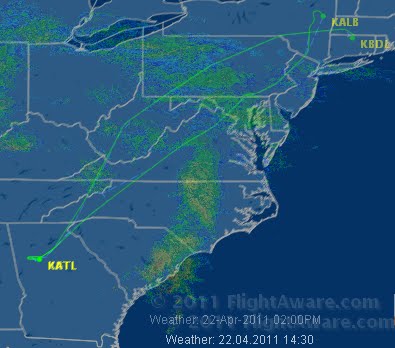
DAL1913 departed Bradley (BDL) first, at 1:09pm, with a flight plan filed over upstate NY to central PA and south over West Virginia. DAL1023 departed Albany (ALB) a few minutes later at 1:12pm flight planed over NJ, eastern PA, overhead DC and then over the Carolinas. Both flights usually fly the eastern route that DAL1023 flew. Both flights' targets merged over the ACOVE intersection just south of ALB, as you see below, and the race was on. DAL1913 was about 2000 feet higher than the DAL1023.

The first flight to arrive was DAL1023, which flew the normal routing to Atlanta (and appears to have deviated around some storms over Maryland), at 3:26pm. Two minutes in-trail was DAL1913, arriving one or two planes back in sequence at 3:28pm.


REPUBLIC (BRICKYARD)

A few days ago, I was sitting in the D-side at Utica and we had two E-170s tied over SYR, both requesting FL360. RPA3305 had departed Montreal (YUL) at 7:47am and RPA3124 who departed Ottawa (YOW) at 7:53am, both bound for Charlotte (CLT). My R-side gave the Ottawa departure, who was a few thousand feet lower in the climb, a vector to the east behind the Montreal departure.

The Montreal departure had filed the normal routing over central PA, West Virginia and and then onto the CLT arrival from the northwest. The Ottawa departure filed Syracuse direct to Roanoke, VA for a different arrival route from the northeast. As strange as this was, it was a Saturday morning, so we simply vectored the Ottawa flight east a little and gave him direct Roanoke, which allowed both flights minimal delay up to FL360 once we had crossed them out and established them on perfectly parallel routes.

Something happened half way to CLT, though. The Montreal departure, who was now west of the Ottawa departure, got massively vectored back east and put well behind the Ottawa departure on the arrival route from the northeast. After all was said and done, RPA3124 (YOW) arrived first at 9:48am, and RPA3305 (YUL) arrived at 9:55am. I'm not sure what happened, as this reroute occurred well beyond my airspace, but I can only assume the YUL departure would have arrived first if nothing had been done, since the flight arrived only 7 minutes behind the other despite the extensive delay vectors.


Till next time...


DM

April 25, 2011

Show Off

The public suddenly has its eyes turned on the Air Traffic Controllers. Really?

There has always been something missing from this Blog, in my opinion. Examples of my actual job, unedited. When I have a fantastically busy session at HNK/DNY -- my perfect phraseology, creative crossing restrictions to ensure separation, subtle vectors when a crossing restriction won't work, my D-side calling New York to get control for lower on the ALB arrivals, delivering Area E some awesome looking in-trail -- I can't ask my supervisor for a recording of my frequency and land lines to upload here, and I can't take a quick screen shot from the Falcon program to show off to you how proud I am of the work that we all do on a daily basis. Giving you access to that information is a security risk, a violation of policy, and copyright infringement. And if you're not a pilot, you'll never get access into my building for a tour to see it all first hand. Instead, I do my best to explain what happened using rudimentary maps, some excellent Flightaware.com links, and my words. I appreciate all of you for following along and your comments and encouragement.

But there are people hovering. Folks just waiting for me to screw up. They're pretty sure I will; I'm human, after all. And when I do screw up there is a major possibility that what I have done, what I've said, and how horrible of a person I am, will be plastered all over the media-scape. Life really isn't fair, after all. I'm not allowed to share with you the 99.9999 percent positive aspects of my work with you here, or anywhere, but that .00001 percent may be used against my entire profession without rebuttal.

Perhaps what I want to show off to you all is too complicated, and people could be afraid of what they don't understand. But the point would be made. What I, and 15000 other air traffic controllers in the US, and tens of thousands more around the world do every day, cannot be explained to the general public in specific terms. And if the public can't understand the positive details, how can they judge us on the negative details?

So maybe we should stay locked up behind windowless doors and just do our work everyday in quiet perfection. Have we created an unfair expectation of ourselves because we do our jobs perfectly almost all the time? Have we silenced ourselves by focusing on undramatic things like "safety"? When the specifics of our rare mistakes are made public but we can't defend ourselves with details of our constant and habitual commendable actions but once a year, getting the flying public home in a safe and efficient manner, then we're loosing an unfair fight. The only thing that gets shown off is a negative image. But that isn't how I see my work at all. If only I could show you.

Till next time...


DM